

{{first_name | Hey}}, welcome back.
Each of this week’s launches opened on something the audience already felt, then showed the product.
Axiom opened its 16M-line post on the "slop" objection.
Higgsfield let a 54-second film carry the pitch.
Aina founder Apoorv Shankar sold three daily scenes before pointing to a ring on pre-order from $399.
Axiom led with the objection, then made the scale visible
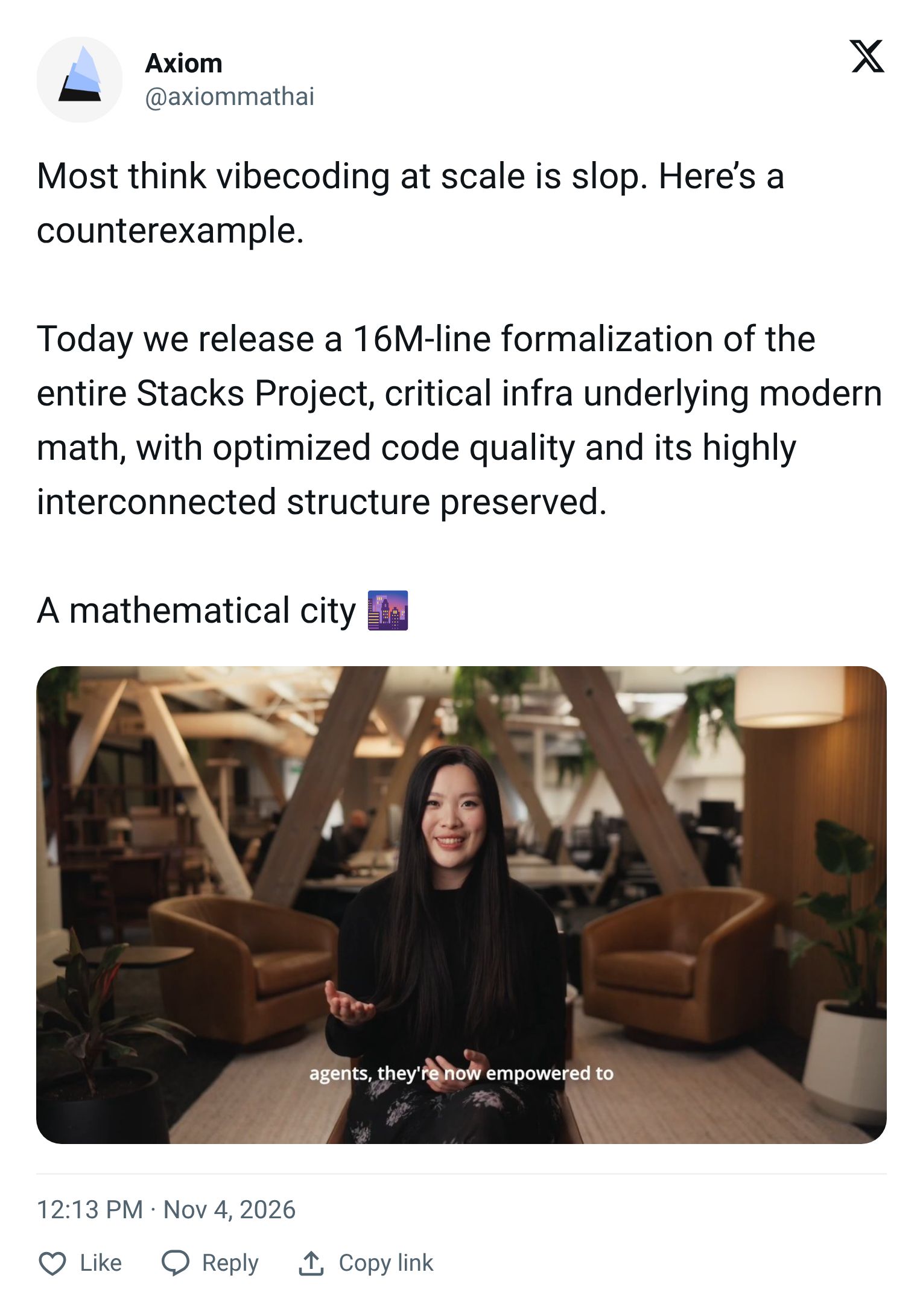
Axiom's 7M-view post opens by arguing with its own audience. The first line is "Most think vibecoding at scale is slop. Here's a counterexample." The 16M-line Stacks Project formalization comes after, as the proof.
The 4:18 film then turns that scale into a picture. The 3D dependency graph rises in pillars like a city skyline, and the post captions it "A mathematical city." Axiom's blog puts it in words: a "roughly 7,500-page" reference became "some 16 million lines."
The city also frames Stacks as something others will build on. The post calls it "critical infra," and in the film Axiom's Vasily Ilin says "we're now inventing a foundation for agents to do the same."
Stacks came eight days after Axiom's CFSG formalization, and the blog calls CFSG "a single landmark theorem" and Stacks "a foundational library."
A doubt-first line survives reposts with no context, and the doubts traveled with it. An outside analysis puts about 97% of formalized tags still awaiting human review. Lean still checks every proof.
The review is whether the statements match the Stacks text. Mathlib maintainer Kim Morrison posted that the release was "pretty good" but "not perfect," and the brand account thanked him.
Higgsfield let a 54-second film be the pitch
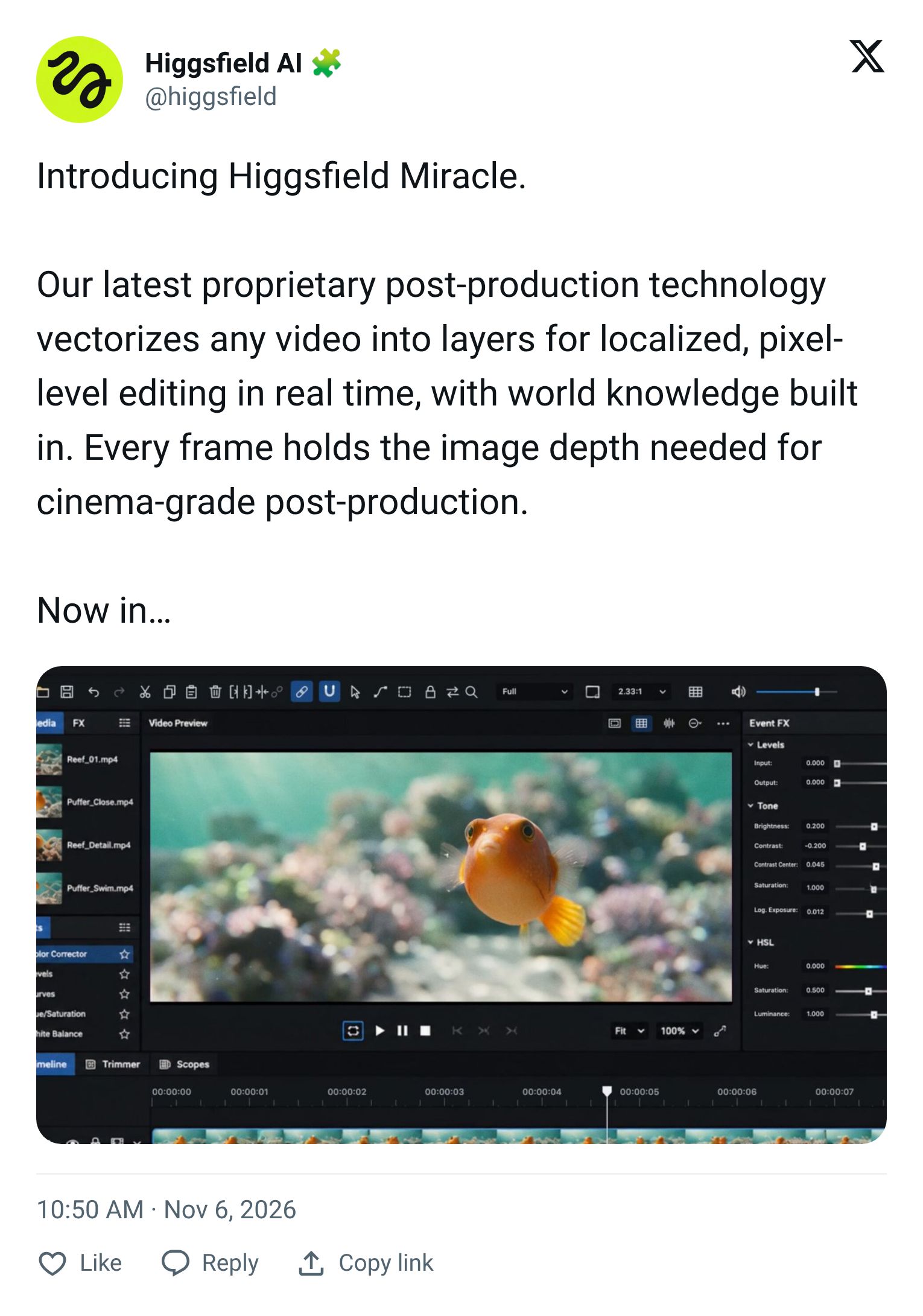
Where Axiom used one visual for scale, Higgsfield let a 54-second cut carry the whole pitch. On-screen labels make it work on mute.
A green tree turns red, a Paris street goes from 9 a.m. light to night, one skater slows down, and Dubai's skyline rewinds from 2026 to 1996. The post calls it "localized, pixel-level editing in real time."
The film also shows a whole editing suite inside one product. Each edit runs under its own tab, from relighting and slowing one skater to rewinding a skyline, so the visual tells viewers they don't need a separate app for every job.
Then the post sends viewers to a tool they may already have open. It ends "Set up Higgsfield MCP in Claude to be the first to try it." Higgsfield's docs add that "An active paid subscription is required."
That step comes with scarcity and a wait. The post says Miracle is "Now in private beta with select testers" and "Coming soon to Higgsfield MCP." Nearly four hours later, a second Higgsfield account replied with a waitlist link, and the Miracle page still says it "is in early testing with selected partners."
Higgsfield had already tested this launch shape. October's Katana post paired a launch video with "Available now in Claude via Higgsfield MCP" and has about 2.5M views. Miracle reused that shape a month later and has 22M.
The quickest way to borrow attention is to ship on someone else's launch day. About an hour after Anthropic announced its new model, Higgsfield quoted the post with “Claude Fable 5.2 is LIVE on Higgsfield,” putting its name on an announcement far bigger than its own. It also flipped its own barrier.
The same MCP that needed a paid plan now came with “3 days of FREE & UNLIMITED access,” so anyone curious about the new model had a reason to try Higgsfield that night.
Aina named the shift, then sold scenes and a ring
This next launch might hit home. If you've used Claude Code or any coding agent, you know the drill: the agent stops at every step and waits for you to hit approve. Aina founder Apoorv Shankar built a ring to make that tap quick, and he started by naming the era it belongs to.
In a September post, he set "the era of Browsing" against "the era of Approvals." The launch post then names the problem. AI "still needs your yes," and it waits "for you to unlock your phone, open an app and tap approve" hundreds of times a day. The demo shows the fix well, and coding is only one part of it.
Then it sells scenes people already live. It lists three, from an Uber booked after breakfast to lights that come on when you get home. Shankar's 1:48 film swaps in four of its own: a Spotify running playlist, an Uber booked as he ties his tie, an email telling his boss he's late, and lights that change at a party.
In each scene the approval happens on the ring, so the hardware becomes the reason to care. The post calls Aina "a ring with a screen" and promises "One flick of your thumb."
On screen, each approval is a press of the side button, which WIRED describes as a joystick-like button you flick. WIRED also reports Shankar was previously vice president of hardware at Ultrahuman.
The path from thesis to pre-order stays inside that one post. It links to aina.com, where pre-orders start at $399, and WIRED says that price rises to $499 once the ring ships in January 2027. Like Higgsfield, Aina let a film show the product while the post carried the next step.
Notable mention: Anthropic’s plain announcement became Higgsfield’s offer
Anthropic introduced Claude Fable 5.2 and Claude Mythos 5.2 in a post saying they’re built for “the most daunting technical challenges.” About an hour later, Higgsfield quoted it with a free trial of its own. A plain announcement is easy for a partner to quote, so write the one line yours can attach an offer to.
Steal this prompt
Run the Asterisk Audit before posting, so the hook and film promise only what checkout delivers.
ROLE: You are a launch editor who has handled expert pushback on product launches.
You check every claim in a launch before it goes live.

[Click below to open full prompt]🔗 Get more such prompts in the Prompting Playbook (free for you) |
Here's how the Asterisk Audit results would look:

4 moves you can run on your next launch

The risk to plan for
Resources and tools worth trying this week
Tools
On Hera's canvas you brief several AI agents at once and get every design back as editable layers.
Click to see plansCheck Dageno to see which brands ChatGPT, Gemini and Perplexity recommend in your market.
Click to see plansType a brief into Magnific Move and it codes motion graphics in your brand kit's colors and fonts.
Click to see plans
Resources
Chagee brand playbook (video interview): Chagee APAC CMO Eugene Lee wrote down the reason behind every brand rule, so new markets keep the brand intact.
Revolve creator strategy (video interview): Revolve, a $1.4 billion fashion retailer, treated creator posts as a global billboard and pulled back on influencer trips once rivals copied them.
Crumbl launch risks (video): Crumbl's Sunday-night flavor reveal built 1.7 million TikTok followers, but a dirty-soda push angered owners, and August sales fell 70% from two years earlier.
Fansville campaign longevity (article): Keurig Dr Pepper chief marketing and innovation officer Drew Panayiotou would rethink Fansville if Dr Pepper fell to fifth or lower in Disney's college football ranking, and says marketers tire of campaigns first.
Mosseri reach advice (video interview): Instagram head Adam Mosseri says sends per reach "matters a ton" and agrees it's key to reaching non-followers.
Which marketing prompt should we build for you next?
Other Interesting Launches
PS. Did you see our AI Tools Directory? It’s a curated collection of 250+ useful AI tools for your profession, business domain, or specific use cases.
Stay curious, {{first_name | readers}}.


