
{{first_name | Hey}}, welcome back.
Four of the most watched companies in tech ran very different plays for attention this year, and the announcement was rarely the thing that won it.
OpenAI put out a model on September 3 and let a screen recording carry it.
On September 9 Apple announced a phone that does not ship until October 23 and set up three news cycles out of the wait.
Back in February this year, Salesforce handed its Super Bowl slot to a YouTuber and turned the ad into a puzzle with a million players. Samsung had nothing to announce and worked Apple's launch day on X instead.
One of those launches, plus two AI features shipped this summer, also shows how fast the people your product touches will tell you what you got wrong. Below is what each did, what it took and a test to run on your own launch before it ships.
OpenAI let the demo do the arguing
OpenAI released GPT-6 Astra on September 3, rolling it out to paid and work accounts over two days at $10 to read and $50 to write per million tokens.
Sam Altman initially shared high test scores, but the internet cared far more about a video showing workers turn a simple yellow circle into a working 3D game just by talking to it.
By day three, Altman quit talking about tests and posted a screen recording of the tool building a game on command, calling the task "obviously trivial."
The official test numbers had strings attached anyway: ARC Prize showed Astra hit 99.9% when given an expensive custom setup, but dropped to 62.7% under standard conditions.
Even when pushed to its limits, the custom setup scored 98.6% against the basic 62.7%, showing why seeing the tool work in a video carried more weight than a test sheet.
OpenAI hit that same reality in March 2025. After adding image generation into ChatGPT, Ghibli-style portraits took over social feeds within hours. Sam Altman posted that server GPUs were melting and capped usage, yet 130 million people generated over 700 million images in nine days.
Appfigures logged 46 million downloads that month, pushing ChatGPT past TikTok because regular users latched onto a cartoon trend the company had not budgeted server capacity to support. Over the 28 days following the release, there were roughly 12 million downloads and about $70 million in revenue tied directly to the update.
Appfigures founder and CEO Ariel Michaeli said much of the jump came down to brand recognition, and that it was "starting to feel like ChatGPT is becoming a verb."
Apple is stretching one phone into three news cycles
Where OpenAI put a working product in front of people, Apple leaned on the clock. On September 9 it introduced the iPhone Duo, its first foldable, with a 7.6-inch inner display, an A20 Pro chip and grade 5 titanium, from $1,999.
Preorders open October 16 and the phone ships October 23, per the same Apple announcement.
Apple CEO John Ternus marked the day by posting the whole slate as a plain list, six products deep.
That 44-day gap is engineered to generate three distinct press beats: the initial keynote hands-ons, the mid-October preorder push, and the launch-week reviews.
The announcement buys the live blogs and the hands-on pieces from Engadget and everyone else on day one. The preorder date is set up to buy a second cycle in October, and the ship date a third, with the review wave behind it. TechCrunch led on the foldable.
Apple put five more products on the same stage, and attention concentrated where the headline pointed it. Counting views on Apple's own YouTube channel about 24 hours after the event, MacDailyNews put the Duo introduction at roughly 8.8 million views against 5.9 million for the iPhone 18 Pro, 473,000 for the Watch Series 12 and 354,000 for AirPods 5.
Top to bottom, that is a 25-to-1 spread across the slate, and it is what to plan for. A supporting product that takes what the headline leaves is a cheaper thing to aim at and an easier one to hit.
There is a supply read on that gap too, and it landed on September 15. Analyst Jeff Pu now expects Apple to ship 6 million Duos this year, cut from 7 million, against 72 million iPhone 18 Pro and Pro Max units, with hinge constraints slowing production, per 9to5Mac.
While the dates were set before supply-chain leaks emerged, the delayed ship date gives Apple room to build inventory against reported hinge assembly bottlenecks.
Samsung spent Apple’s launch day posting
On September 9, while Apple was on stage, Samsung Mobile US was live on X, in a sequence Exchange4media logged post by post.
The posts tracked the keynote in order. "So far, so same. #ItsTimeToSwitch" went up early, "Accessories? It's giving condiments and no food" followed the accessory segment, and when the foldable appeared Samsung wrote "Let us know when you're done reheating our leftovers."
Samsung signed off with a scorecard: "Was there range? No. Was it exciting? No. Did it happen? Yes." Commentary at that pace runs on approvals settled before the event rather than during it, and that is what a communications team has to build in advance.
Samsung's regional accounts followed on other platforms, including Samsung Canada running "Imitation is the sincerest form of flattery" over a video of its own foldable on Instagram, and Samsung Philippines posting "Allow us to reintroduce ourselves. 8 years in and still ahead of the fold."
Motorola played it differently, posting a folding video that nodded to its razr line with the words "New in their hands. Iconic in ours," per Marketing-Interactive.
Duolingo had the best angle of anyone that day, because the phone shares a name with its mascot. Its first post, "they named a phone after me and made it bend over," had reached 9.7 million views and 97,000 likes by September 16.
Samsung tried to recruit it, replying "I'm so sorry, @DuoLingo. They copied us too #Solidarity." Duolingo declined the alliance, quoting the post back with "when an ugly stranger calls you twin. No Brand." By September 16 Duolingo's reply had passed 10.5 million views and 174,000 likes.
That one landed at 18:05 UTC, 20 minutes before Ternus posted the product slate, so Duolingo's line was circulating before Apple's own summary was. Duolingo then closed on price: "iPhone Duo: $1999. Duo on your iPhone: free."
Three posts in four hours, from a language app that does not make phones. Samsung was posting as a competitor with a rival product in the same category, and that shapes how a joke reads. Duolingo had no position to defend, so it could refuse the alliance and price-check a foldable in the same afternoon.
Marketing-Interactive counted 13 brands beyond Samsung posting that week, Duolingo and Motorola among them, and most of the rest had nothing to do with phones. Canva split a foldable between "what the client asks for" and "what you want to design," captioned "Don't put all your apples in one basket." Domino's ran two pizzas as the Duomino, with the line "We did it first."
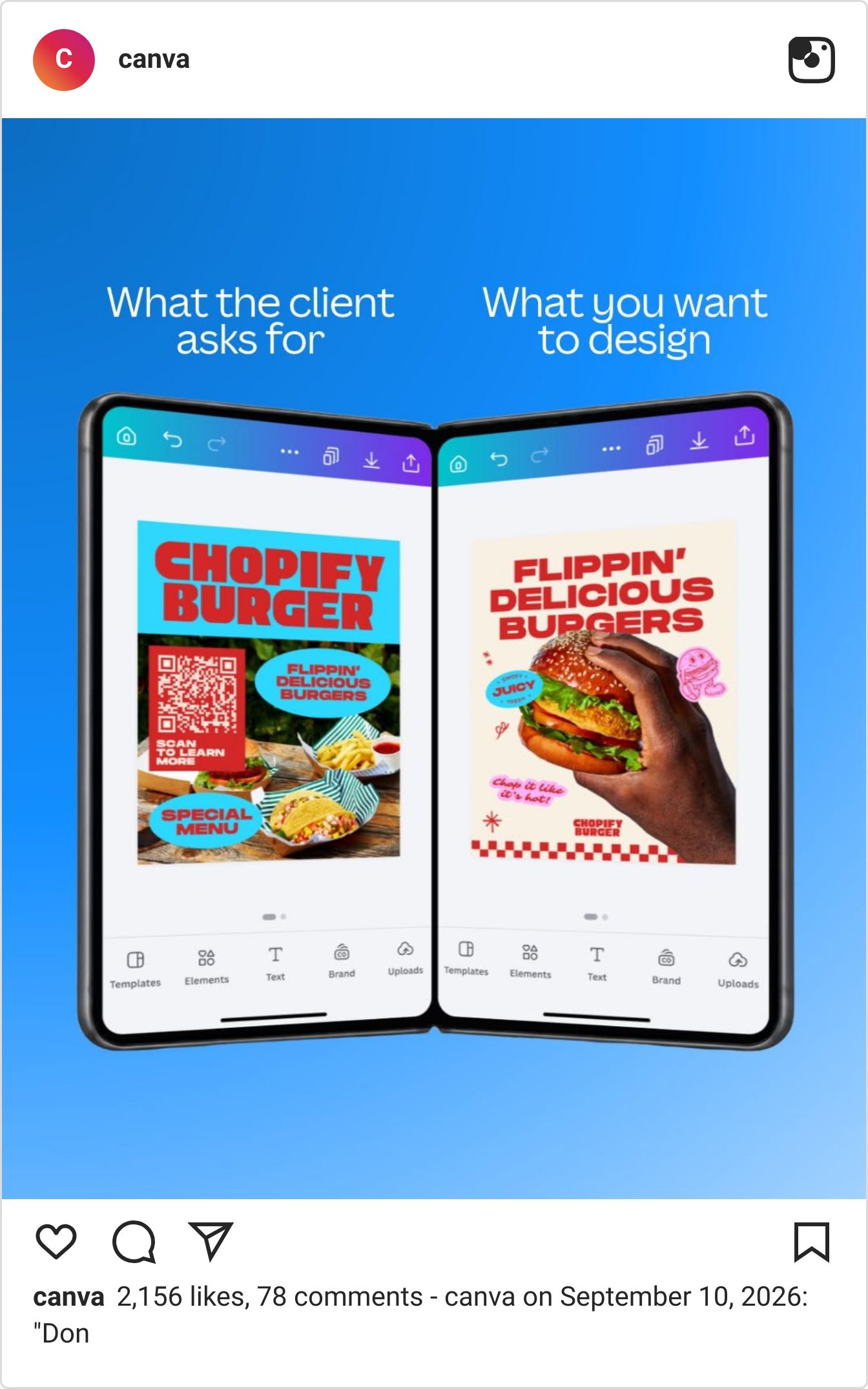
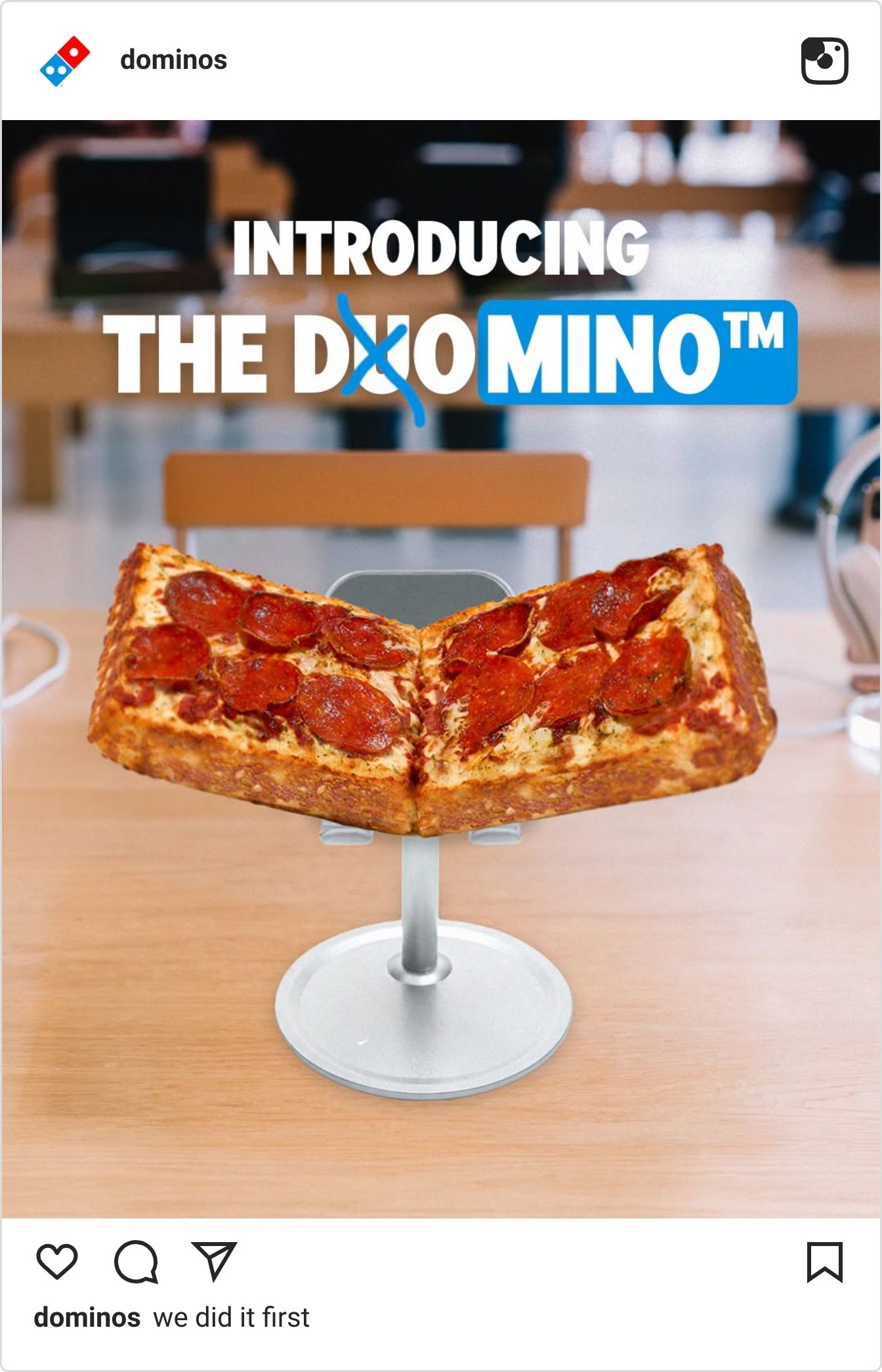
Reactive social posts generate awareness rather than direct pipeline. Without published conversion data, Duolingo’s win remains strictly an impressions story.
The reach that is on the record went to Duolingo. Its first post and its reply to Samsung cleared 20 million views between them on those figures, on a platform where Samsung was working all day. What Samsung bought was a week in the marketing press for the cost of a social team on standby. That is the honest ceiling on this play, and it is still worth having.
What Super Bowl 60 cost and what brands bought instead
Samsung got Apple's launch day for free. The stage everybody does pay for had been repricing all year, and the price is where that story starts. 30 seconds of media time started at $8 million, per eMarketer. Against that, The Hollywood Reporter reported A-tier celebrity fees settling into the $3 to $5 million range, with WME senior partner Tim Curtis saying "the days of a $10-or-15-million-dollar payday for a Super Bowl commercial are largely over, with some rare exceptions."
The same reporting described brands spreading that spend across an ensemble instead, and Range Media Partners' head of brand marketing and endorsements Carol Goll gave the reason: "they're really trying to meet different demographics." Hollywood names still carry roughly 60% of Super Bowl ads, per System1, and what changed in 2026 is how a brand splits the budget across them.
Marketing Dive tracked where that money went. Poppi bought Charli XCX and Rachel Sennott, and Fanatics Sportsbook took Kendall Jenner. Meta ran the full ensemble version, two spots for Oakley Meta Performance AI glasses, with a seven-person cast that put streamer iShowSpeed and filmmaker Spike Lee next to Marshawn Lynch and four other athletes.
Salesforce went further, and the timeline is what a CMO can lift from it. In late December 2025 MrBeast posted that he had been sitting on a Super Bowl idea for years and wanted a brand to build it with. Marc Benioff answered him in public on New Year's Eve, US time: "Very seriously, Jimmy you should really do our Salesforce Super Bowl commercial for 2026!"
Variety reported the deal that followed. What shipped was an ad in name only. The 30-second spot fronted a live puzzle hunt that players solved through Slackbot, with clues hidden across the commercial, the behind-the-scenes footage and the social posts. The first to solve it won $1 million.
The numbers Salesforce published are where the play gets useful. Over a million players used Slackbot to work the puzzle. The platform was built in six weeks and sized for 1.5 million simultaneous users, 10 million registrations and roughly a trillion token requests across the first 72 hours. Its Trust Layer logged 64,000 prompt attacks, and Salesforce reported that 99.997% were blocked without a human involved.
Benioff put the traffic number out within hours of the spot airing: "We've had over 53M people hit this page since the spot ran. 1.32M in the last 15 minutes."
That is a product stress test dressed as entertainment. The block rate is still Salesforce's own number on Salesforce's own page, but the traffic behind it came from a million strangers in public, which is more than most vendor demos can say. Registration emails did back up on game night, and Salesforce said at the time it was working through the problem with the major email providers. That is the price of testing where everyone can see.
Salesforce says the commercial was produced inside those six weeks, in 27 days with a crew of over 500. Its chief brand and creative officer, John Zissimos, put that down to the partner: "MrBeast is known for running incredibly fast-paced, high-stakes operations." Salesforce credits the condensed 27-day production turnaround to MrBeast’s in-house production setup rather than standard agency workflows.
The feedback arrives in days
Every play so far has depended on people outside the company. Those people answer back, and three launches heard from them within days. Start with the Astra video, the one that carried OpenAI's launch. Blender does the modeling on screen in it. Blender is free, open source and built by a community, and nobody from that community appears anywhere in the frame.
Creative Bloq collected what came back three days later, including a note from an artist whose work had appeared in Blender's own splash screen. The asset that won the launch wrote the second story too, and nobody had to commission a word of it.
The same loop can close inside a day. On July 30 Google put Nano Banana 2, its image generator, inside Google Earth, so users could generate imagery on top of satellite maps. The BBC's Shayan Sardarizadeh put the objection sarcastically, per TechCrunch, writing that there was "no way" a generator inside "one of the most reliable sources of visual evidence for journalists and researchers" could possibly be abused to spread misinformation.
Google pulled the feature on July 31 and sent it back for stronger guardrails, saying it had "seen people sharing screenshots of generated imagery that appear to violate our policies." Google pulled the tool within 24 hours to re-evaluate the risk of fabricated satellite imagery circulating on an analytical platform.
Meta had been through the same cycle three weeks earlier. Its Muse Image generator on Instagram let people create images by @-mentioning public accounts, and users and talent agencies including CAA pushed back on the mention feature. Meta pulled the @-mention capability within days, per TechCrunch, with a line worth copying: "We've heard the feedback that this feature missed the mark, so it's no longer available."
Each launch turned up a group nobody had thought to ask, and none of the three was hard to find in advance. Google and Meta both moved within days and said so publicly, which is the right answer once the feedback is already public. Feedback arrives at that speed either way, and asking those groups first costs one meeting while you can still act on what they say privately.
Which marketing play did you like best?
The carry test
In each case above, the carrier was something other than a press release. Pick the one your product and your budget can support. Each has a precondition and a cost.
The demo: Astra's benchmark page and its demo video shipped the same day, and the coverage kept returning to the video.
Precondition: A product a stranger can understand in 10 seconds with no context.
Cost: a screen recording and the engineering time to make one worth watching.
The users: One consumer feature had 130 million people using it inside nine days and put the app at number one worldwide that month.
Precondition: Something a non-customer can use and post in under a minute.
Cost: Little to build, and a serving bill with no ceiling on it. Ship several and watch, because the one that lands is rarely the one on the roadmap.
The calendar: Apple left 44 days between announcing the Duo and shipping it, and has banked the first of the cycles that gap makes room for.
Precondition: A product you can announce before it is buyable.
Cost: No cash, but a 44-day window in which a buyer can wait instead of buying. Price that against this quarter's sales, and if you can count on only one cycle, put the gap where you most need the coverage.
The partner: MrBeast pitched in public, Benioff answered within days, and Salesforce got a Super Bowl spot built in 27 days plus a live stress test with a million users.
Precondition: An executive who reads their own replies, and a product you would be willing to load-test in public.
Cost: Real money on top of the media buy, and a team on call the night it runs.
Someone else's launch day: Samsung and 13 other brands posted through Apple's launch week, and the one that out-reached everybody had no phone to sell.
Precondition: A real connection to the story, which for Motorola was the razr and for Duolingo was the name.
Cost: A social team cleared to post, with the approvals settled before the day starts. Without hardware sales on the line, Duolingo was free to mock the category entirely, netting 20 million views across two posts after beating Apple’s own executive summary to the timeline by 20 minutes.
One check applies before any of the five: name every group your launch puts on screen or speaks for, and write down what the launch says about their work. Blender's artists, Earth's journalists, and Instagram's agencies all wrote that down in public for companies that didn't bother to ask in private.
Other Interesting Launches
PS. Did you see our AI Tools Directory? It’s a curated collection of 250+ useful AI tools for your profession, business domain, or specific use cases.
Stay curious, {{first_name | readers}}

