

{{first_name | Hey}}, welcome back.
An executive in a dark boardroom tells his laptop the team has "been overachieving in all of our KPIs, particularly in the APAC regions." His glasses, meanwhile, report that he's at peak focus. It's a scene from the STASIS launch film, and it's aimed at whoever signs the wellness budget.
STASIS, from YC's Fall 2026 batch, sells glasses that read your eyes. Arcfront, from a co-founder of Scaler, sells AI training data built from how experts make decisions. Corma builds AI that defends companies from hackers. Liquid AI sells models that make decisions and rate their own certainty. Each one started from something its buyer already believed, then sold the gap.
By the end of this piece you'll know how to position a new product against tools your buyer already pays for, how a paradox makes buyers feel a problem, how a funding round becomes a cause other people repeat, and why a pricing model belongs in the opening pitch.
STASIS sold the one body part your gadgets ignore
STASIS picked its rivals from the buyer's own jewelry box. "Your ring tracks your heart. Your watch tracks your sleep. Nothing tracks the eyes and brain running the show," says the launch, and that's the whole positioning. It never argues that self-tracking matters, because the buyer settled that at the checkout for the ring. On its YC page, STASIS borrows a category leader to say the rest: "The WHOOP for 16 billion eyes."
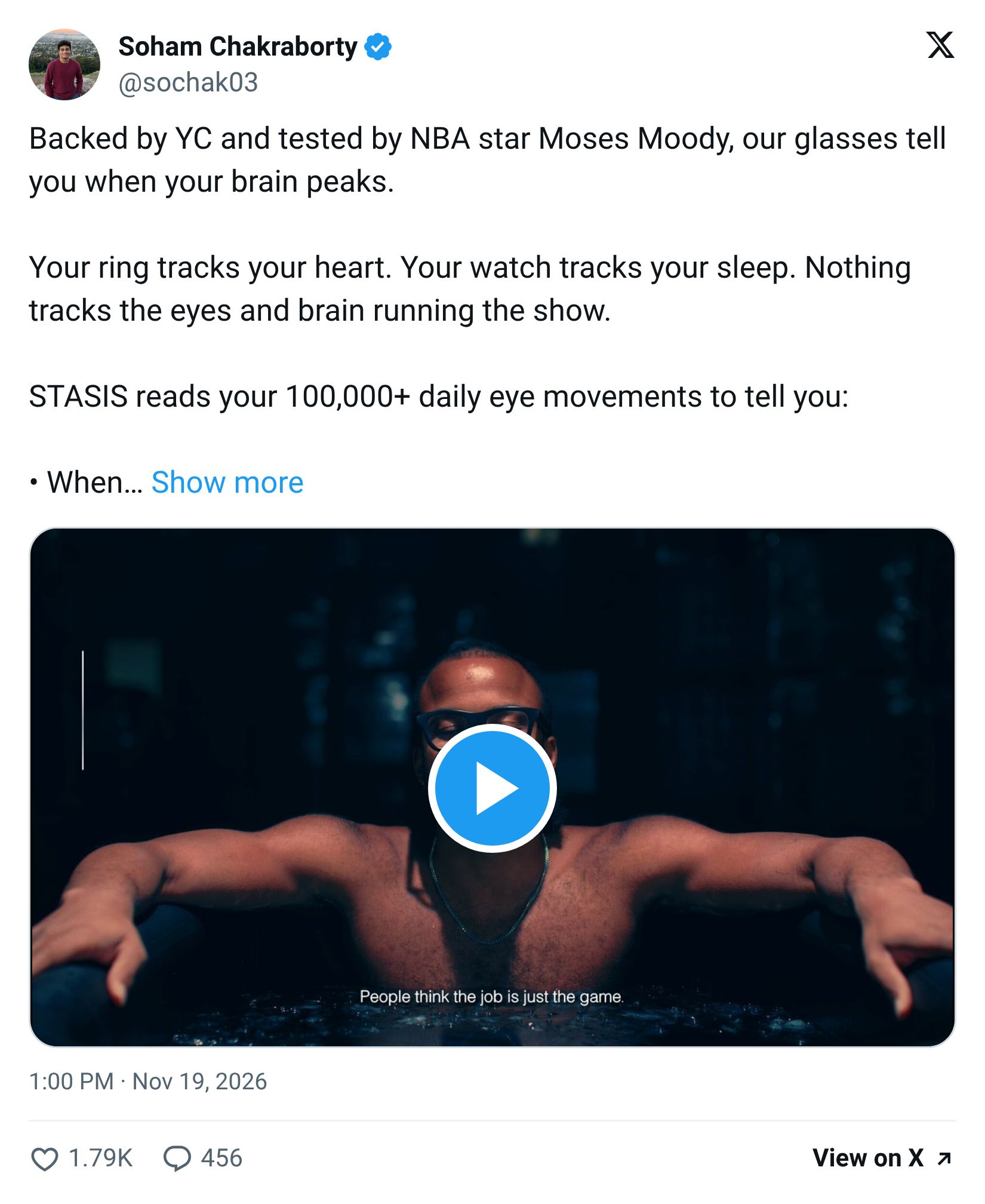
STASIS also borrows trust. It name-drops YC and "NBA star Moses Moody" in its first line, and its film lets Moody carry the credibility while the boardroom executive carries the budget. Co-founder Soham Chakraborty confirmed the budget angle in a reply: "we're already talking to teams about rolling it out as a wellness benefit." The price objection is gone before anyone raises it. A refundable $99 deposit holds a $299 pair, and it's HSA/FSA eligible, so buyers can pay with pre-tax health money.
One caution: the post says "92% accuracy" and the site says "90%+." Two numbers for one claim give a skeptic an easy first question.
Steal it: Name the tool your buyer already pays for and the job it leaves undone, then cast a user your buyer's boss would recognize. At enterprise scale, cast a customer's executive, and write one scene for the budget owner who never touches the product.
Arcfront made buyers feel the problem before selling the fix
Arcfront had no NBA guard, so co-founder Anshuman Singh put customers on the marquee. He writes "In under a year, four of the five frontier labs became customers" in line two of his launch, ahead of any pitch. Proof goes first because the story asks for patience.
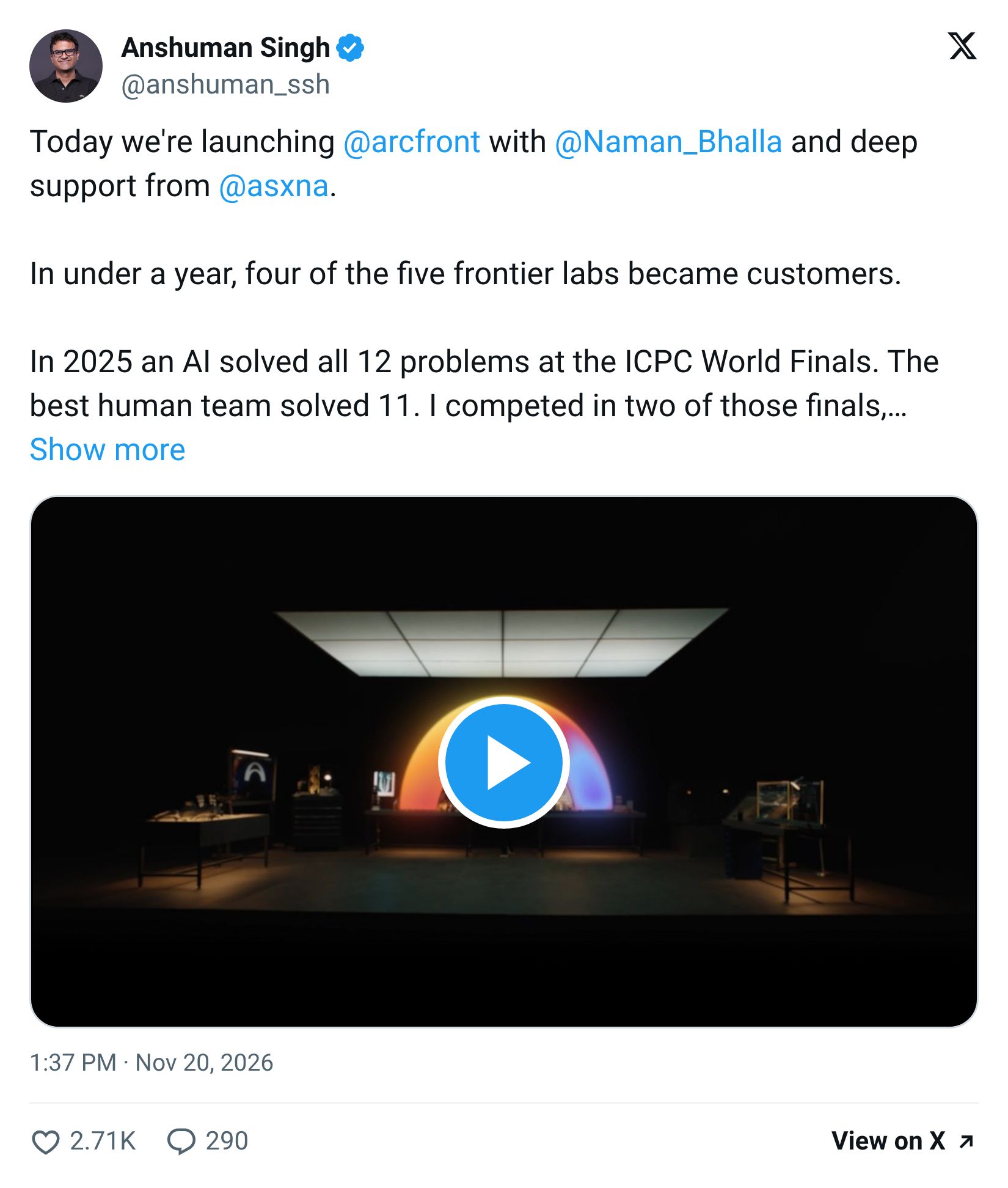
The story runs on a paradox the buyer already half-believes. AI is brilliant, having solved all 12 problems at the 2025 ICPC World Finals, where the best human team solved 11. Yet, Singh writes, "put that same AI inside a company as a finance manager... and it fails on day 1." Anyone who has watched an AI pilot stall nods along, and Singh ends on "Why is that?" so the reader leans in.
Singh answers with a history lesson in his thread. William Halsted started the first surgical residency in 1889, "because reading about surgery doesn't make a surgeon." AI has read the books and still lacks judgment, so Arcfront sells the record of how experts decide and brands it "Decision Arc Data." A product name for an abstract idea gives a buyer something to put on a purchase order. Arcfront's brand account replied with the pocket version: "Knowledge is knowing a tomato is a fruit. 🍅 Judgment is keeping it out of the fruit salad.🤪"
Steal it: Put peer proof in line two, and frame the problem as a paradox your buyer has already lived. For a large vendor, the best paradox is often your industry's own benchmark win that customers can't reproduce at work.

📚 Library of past Launch Breakdown issues.
📢 If your launch date is close, line up your first readers before the post goes live. We put products in front of 100K+ readers, so send us the brief on what you’re shipping.
Corma turned a funding round into a cause
Arcfront's villain was a paradox. Corma picked one with a keyboard. CEO Alon Pluda gets the money out of the way in one line of his post, $125M at a $1B valuation, three months out of stealth. He spends the rest on the enemy: "the greatest gift cyberattackers have ever received is smarter AI, and right now only one side is armed. Arm the defenders."
Security buyers already fear AI-armed attackers, and Corma gives that fear a name and a number. Its blog calls a wave of breaches "Black October." Its own research found frontier models planted backdoors in 85% of runs but caught only 19% of attacks when playing defense. An enemy with a date and a measured gap is hard to wave off in a budget meeting.
A cause gives people off the payroll something to post. Corma handed the WSJ a day-one exclusive, and the slogan was short enough that a fan's post signed off with it. Corma's film never shows a product, only fire, an Enigma machine, a hard hat and a radar dish. The site explains the name: it's Quenya for ring, as in the One Ring, "this time, for the defenders." Tolkien fans in the security team will take that personally.
Steal it: Announce money as a mission against a named enemy, and close on a line short enough for an investor to repost. At big-company scale, the same wrapper fits an earnings beat or a flagship customer win.
Liquid AI sold confidence and a predictable bill
Liquid AI picked a calmer pitch than Corma's war cry. Its d1.2 "decision models" read an invoice and return the amount due, or "not found" instead of a guess, per the blog. Buyers already believe AI sounds sure when it's wrong, so Liquid makes a promise in its thread: "When it says 80%, it should be right about 80% of the time," which lets low-confidence work go to a person. For a risk team, that's an AI with an escalation path built in.
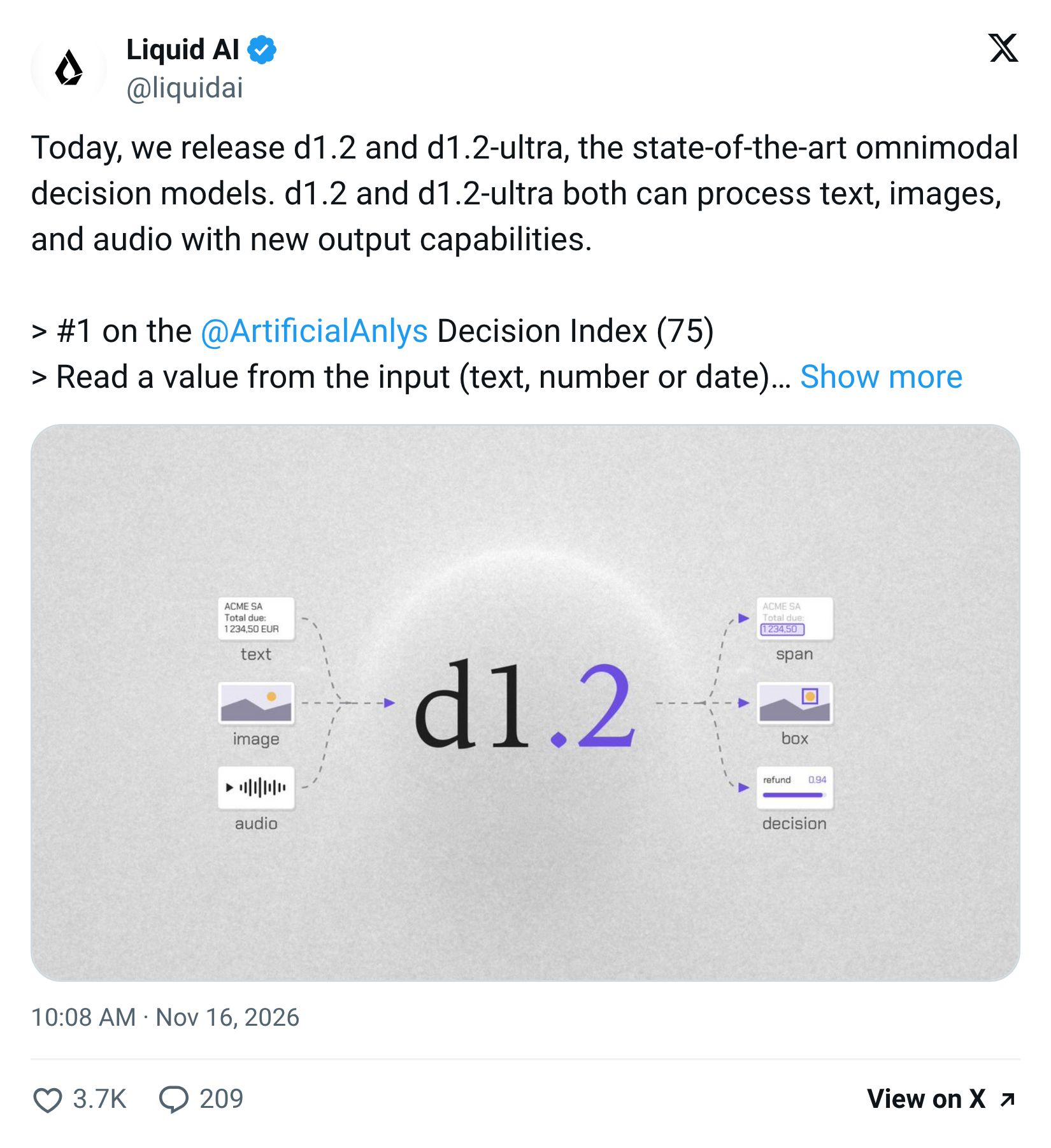
The bill is the other worry, since most AI APIs charge for output as well as input. Liquid bills only what goes in, and its pricing post says so plainly: "You only pay for inputs, there are no output tokens." The list price is $0.02 per million input tokens for d1.2, so finance knows the cost of a job before the model answers.
That pricing model is a positioning line, yet Liquid led its opener with "#1 on the @ArtificialAnlys Decision Index" and saved the billing line for the fifth post, where few readers scroll. A bill set by what goes in is the line a CFO would repeat in a budget review.
Steal it: If how you charge is different, make it the headline and put it in the first line next to the benchmark. At keynote scale, lead the pricing slide before the leaderboard.
Steal this prompt
Run the Belief Gap Editor on your launch draft. It finds your buyer's existing belief and rewrites your opening post around the gap.
Role: You are a launch strategist for B2B and AI product launches on X.
You build every launch on a belief the buyer already holds, then sell the gap.
Inputs: Paste each one. Write "none" if you don't have it.
1. DRAFT: your launch post or thread as written, post by post, numbered.

[Click below to open full prompt]Every number in the output should trace to your inputs. Gaps show as [missing].

🔗 Get more such prompts in the Prompting Playbook (free for you) |
4 moves you can run on your next launch

Resources and tools worth trying this week
Tools
VEED AI is a video editing agent. Drop in footage and a product link, and it edits a cut with subtitles in your brand's style.
Click to see plansBefore your launch cites a leaderboard, check what it scores. The Decision Index Liquid AI topped penalizes confident wrong answers.
Try Liquid's d1.2 on OpenRouter to tag inbound leads or support tickets, and route anything it's unsure about to a person.
Resources
Asana's repositioning (podcast): Asana CMO Prachi Gore on moving Asana from project management to "work execution" and the launch playbook behind it. Pairs with the STASIS move.
Serko's self-disruption (podcast): Serko CMO Nick Whitehead on launching Serko AI, a product built to make the company's own booking tools obsolete. Pairs with the Arcfront move.
Corma's offense-defense research (report): The study behind the 85% and 19% figures, and a template for turning a market fear into data you own.
Study: Mitchell, who runs the viral video studio Shown Media, broke down 100 AI launch videos with 941 million combined views to find out whether follower count, video length or brand size decides which launches take off on X.
Your AI launch gets one line before the scroll wins. What actually goes in it?
Other Interesting Launches
PS. Did you see our AI Tools Directory? It’s a curated collection of 250+ useful AI tools for your profession, business domain, or specific use cases.
Stay curious, {{first_name | readers}}.


